Private Label Sunscreen: The Complete Guide to Aerosol SPF Manufacturing
Private Label Sunscreen: The Brand Owner’s Complete Guide to Aerosol SPF Manufacturing
Sun care is one of the fastest-growing segments in personal care and one of the most technically demanding to manufacture. If you’re exploring private label sunscreen as a product launch or line extension, you already know that SPF products aren’t like other cosmetics. They’re regulated as over-the-counter drugs by the FDA, they require specialized aerosol filling equipment, and their formulations must survive stability and efficacy testing before a single can hits retail shelves.
The good news: the right contract manufacturing partner handles all of that complexity for you. This guide covers everything brand owners need to know , from product formats and regulatory requirements to what separates a qualified private label sunscreen manufacturer from one that creates costly problems down the road.
And if you’re ready to talk specifics, Signature Filling Company’s personal care aerosol filling services are purpose-built for exactly this kind of project.
Why Private Label Sunscreen Is a Smart Brand Play Right Now
The global sun care market has expanded consistently year over year, driven by rising consumer awareness of UV-related skin damage, the growth of outdoor recreation culture, and increasing demand for clean, reef-safe, and mineral-based formulations. Brands that build a credible SPF line now are positioning themselves ahead of a category that shows no signs of slowing.
Private label sunscreen specifically offers a compelling path to market because:
- Validated formulas already exist — private label manufacturers maintain tested, FDA-compliant SPF bases that have already gone through stability and efficacy testing, dramatically shortening the path from concept to finished product
- Capital requirements are low — you leverage the contract manufacturer’s equipment, certifications, and compliance infrastructure rather than building your own
- SKU flexibility is high — aerosol sunscreen sprays, pump sprays, sticks, and lotions can all be produced through a single partner, giving you a coherent multi-format sun care line
- Brand differentiation is achievable — through custom formulation, fragrance selection, active ingredient combinations, and packaging design, even a private label product can carry a distinctive brand identity
For indie brands, wellness startups, outdoor gear companies, resort and hospitality brands, and cosmetic retailers looking to expand, private label sunscreen represents a rare combination of accessible entry and meaningful margin potential.
Private Label Sunscreen Formats: Aerosol Spray, Pump, Stick, and Lotion
One of the first decisions in a private label sunscreen project is the delivery format. Each has different manufacturing requirements, consumer use cases, and retail positioning:
Aerosol Sunscreen Spray
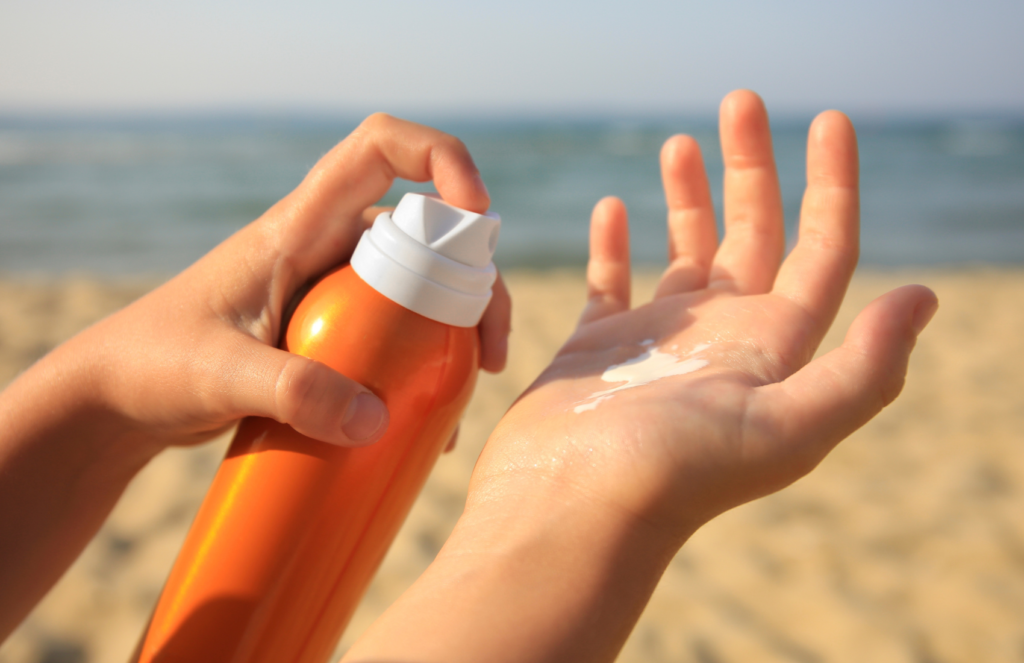
The aerosol spray format, particularly when produced via bag-on-valve (BOV) technology, is the fastest-growing segment in sun care. Aerosol sprays are convenient, quick-drying, and well-suited to active outdoor use. The BOV format specifically offers significant advantages for sunscreen: the product never contacts the propellant (compressed air or nitrogen), meaning no chemical interaction with delicate active ingredients like zinc oxide or avobenzone. The can also sprays reliably at any angle, critical for reaching the back, shoulders, and other hard-to-reach areas.
For brands prioritizing clean, reef-safe, or mineral sunscreen formulas, BOV aerosol filling is often the ideal production method because it delivers a cosmetically elegant, propellant-free product experience.
Pump Spray Sunscreen
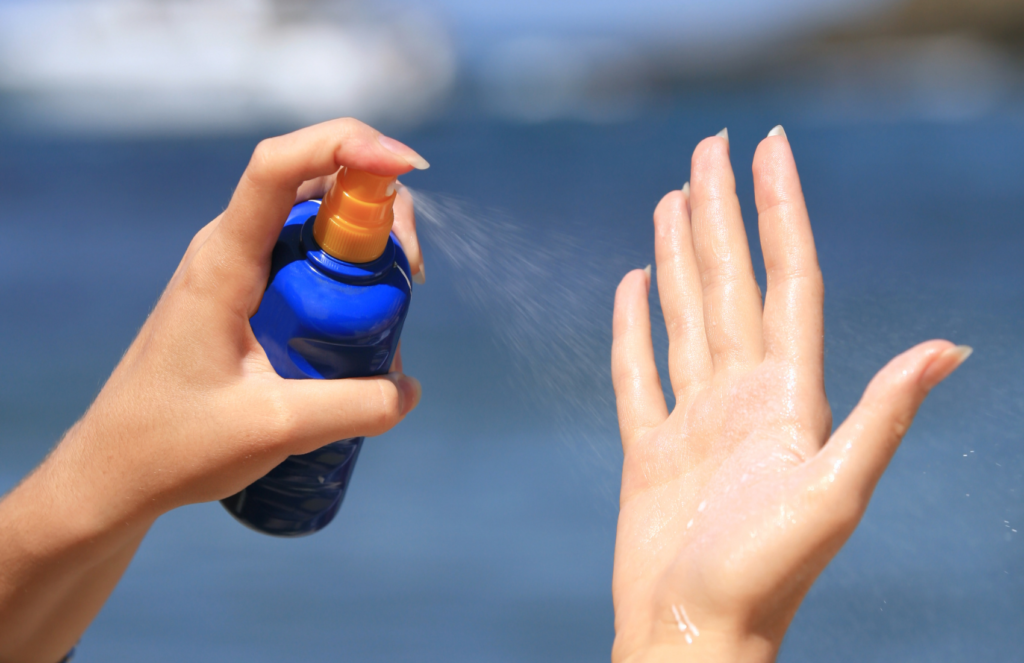
Non-aerosol pump sprays are a popular alternative for brands seeking to avoid pressurized packaging entirely, or for formulas that don’t perform optimally in aerosol systems. Pump sprays work well for lighter-viscosity formulations and are commonly used in the facial SPF segment, where precise, controlled application is valued.
Sunscreen Stick
Stick format sunscreens are highly portable, mess-free, and particularly popular for children’s lines, lip care with SPF, and targeted facial application. They require filling into stick molds and appropriate packaging, a capability to confirm explicitly with your contract manufacturer.
Lotion and Cream Sunscreen
Traditional lotion and cream formats remain the largest volume segment globally. Available in a wide range of viscosities, from lightweight daily moisturizer SPF to heavy-duty sport cream, lotions are typically filled into tubes, jars, or pump bottles. This format is well-suited to premium formulations with added skincare actives (hyaluronic acid, antioxidants, niacinamide).

FDA Regulation of Private Label Sunscreen: What Every Brand Owner Needs to Know
This is the section that trips up most first-time sunscreen brand owners: in the United States, sunscreens are regulated as over-the-counter (OTC) drug products by the FDA, not as cosmetics. This has significant implications for manufacturing, labeling, and quality control.
OTC Monograph System
Sunscreens sold in the U.S. must comply with the FDA’s OTC Drug Monograph for sunscreen products, which specifies approved active ingredients, concentration limits, labeling requirements (including the Drug Facts panel), and testing protocols. Common approved actives include zinc oxide, titanium dioxide (mineral), avobenzone, octocrylene, and homosalate (chemical).
FDA Registration
Facilities that manufacture OTC sunscreen products must be registered with the FDA as drug establishment registrants. This is a non-negotiable requirement, manufacturing in an unregistered facility disqualifies your product from legal U.S. sale. When evaluating private label sunscreen manufacturers, FDA registration should be one of the first boxes you check.
SPF Testing
Sun Protection Factor claims (SPF 15, SPF 30, SPF 50, etc.) must be substantiated through FDA-accepted testing protocols, typically conducted by accredited third-party laboratories. Broad-spectrum claims also require specific testing to verify both UVA and UVB protection. Your contract manufacturer should be able to provide documentation of SPF testing for any private label formula you’re considering.
Labeling Requirements
OTC sunscreen labeling is strictly regulated. Products must include a Drug Facts panel listing active ingredients, inactive ingredients, SPF value, directions for use, warnings, and other required disclosures. Your contract manufacturer should have regulatory support capabilities to ensure your labeling is compliant before production begins.
For a comprehensive overview of the FDA’s sunscreen requirements, the FDA’s official OTC sunscreen guidance page is the authoritative reference.
Private Label Sunscreen Formulation Options: Mineral, Chemical, and Hybrid
The active ingredient system in your sunscreen is the core of your product’s performance positioning and consumer story. Here’s how the major formulation categories compare:
Mineral Sunscreen (Physical UV Filters)
Mineral sunscreens use zinc oxide and/or titanium dioxide to physically block and scatter UV radiation. Key selling points include broad-spectrum protection, stability in sunlight, compatibility with sensitive skin, and suitability for reef-safe and clean beauty positioning. Mineral formulas, particularly those using non-nano zinc oxide, command premium pricing and strong retailer demand in the natural and specialty beauty channel.
In aerosol format, mineral formulas require careful formulation and suspension management to prevent settling, making an experienced contract manufacturer’s formulation expertise especially valuable.
Chemical Sunscreen (Organic UV Filters)
Chemical sunscreens use organic compounds (avobenzone, octocrylene, homosalate, octisalate, and others) that absorb UV radiation and convert it to heat. They tend to be lighter in texture, more cosmetically elegant, and easier to formulate in aerosol systems, particularly for continuous spray formats. They’re well-suited to sport and active outdoor positioning.
Hybrid Formulations
Hybrid sunscreens combine mineral and chemical actives to optimize both protection profile and cosmetic aesthetics, capturing the broad-spectrum strength of zinc oxide while maintaining the lightweight feel of chemical actives. These are increasingly popular in the premium facial SPF and tinted sunscreen segments.
How to Choose a Private Label Sunscreen Manufacturer: 7 Critical Criteria
Not every contract filler is equipped to handle sunscreen. OTC drug manufacturing requirements, aerosol-specific equipment, and the formulation complexity of SPF products narrow the field significantly. Here’s what to look for:
1. FDA Registration and OTC Drug Manufacturing Experience
Confirm that the facility is registered with the FDA as an OTC drug manufacturer, not just a cosmetic manufacturer. Ask specifically about their sunscreen production history: how many SPF products have they brought to market, and in what formats?
2. BOV Filling Capability for Aerosol SPF
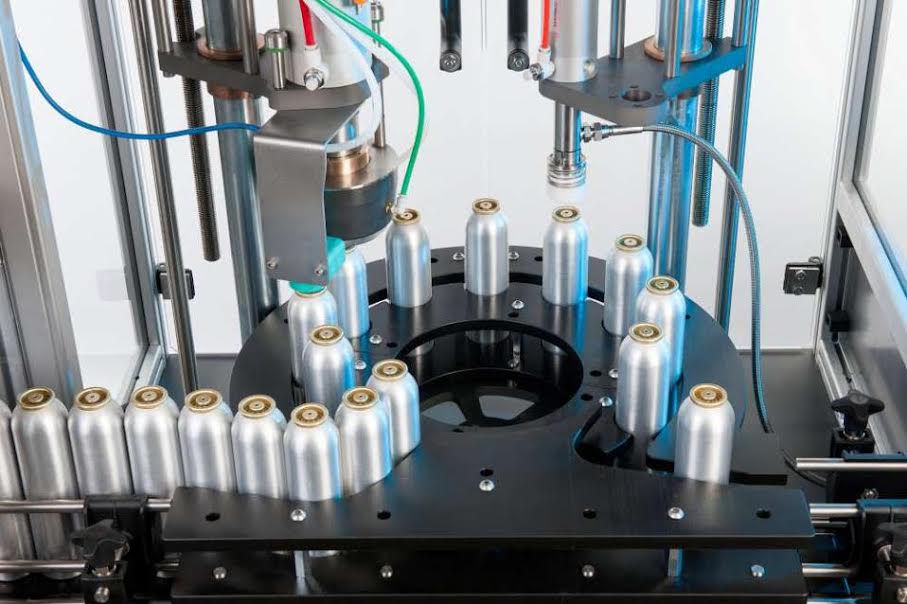
If aerosol spray is your target format, confirm that the manufacturer has actual bag-on-valve filling infrastructure. BOV is not a feature that can be improvised, it requires dedicated equipment, trained operators, and validated processes. Signature Filling Company operates BOV filling lines specifically designed for personal care products including sunscreen, with compressed air and nitrogen propellant capability.
3. SPF-Tested Private Label Formulas
The fastest path to market is a private label manufacturer who maintains a library of already-tested, FDA-compliant SPF bases. Ask to see the testing documentation: SPF value substantiation, broad-spectrum testing, water resistance claims (if applicable), and stability data.
4. Formulation Customization Capability
Even in a private label model, you should be able to customize fragrance, texture modifiers, and supplemental skincare actives (antioxidants, botanical extracts, hydrating agents). Ask what’s adjustable versus fixed in the base formula.
5. Packaging Range and Labeling Services
Sun care products span multiple packaging formats. Your manufacturer should handle the full range relevant to your line, along with in-house labeling, lot-coding, and tamper-evident sealing. Keeping post-fill finishing under one roof simplifies your supply chain and reduces lead time.
6. Minimum Order Quantities That Match Your Business Stage
Private label sunscreen MOQs vary widely. Large commodity contract fillers may require 50,000+ units per SKU, unworkable for a brand launch. Look for a manufacturer that supports smaller introductory runs, giving you the ability to validate the market before committing to large inventory positions.
7. Regulatory Support for Labeling Compliance
OTC drug labeling for sunscreen is complex and strictly enforced. Your contract manufacturer should offer regulatory review of your Drug Facts panel, active ingredient claims, and labeling copy before the print run is finalized, or be able to direct you to a trusted regulatory consultant.
Why BOV Aerosol Is the Superior Format for Premium Private Label Sunscreen
Of all the sunscreen formats, aerosol BOV spray is particularly well-suited to brand differentiation. Here’s why brands choosing a premium positioning consistently gravitate toward bag-on-valve sunscreen production:
- No propellant contact with the formula — protects sensitive mineral actives and botanical additions from chemical interaction
- 360° spray at any angle — consumers can apply to their own backs, shoulders, and hard-to-reach areas without assistance
- Up to 99% product evacuation — consumers get nearly every drop of product, reinforcing the premium value proposition
- Non-flammable propellant — compressed air and nitrogen BOV cans are non-flammable, simplifying retail shelf placement and reducing DOT shipping classification concerns
- Clean-label compatibility — no hydrocarbon propellants means no VOC content to disclose, supporting green beauty and clean-label positioning
- Consistent spray pattern — delivers uniform coverage regardless of can orientation or remaining fill level
For a deeper look at how BOV technology works and why it’s become the standard for premium aerosol personal care, see our complete bag-on-valve guide.
Private Label Sunscreen Timeline: What to Expect From Inquiry to Launch
Understanding the typical production timeline helps you plan your launch strategy and set realistic expectations with retail buyers, distributors, and marketing teams.
Weeks 1–2: Initial Consultation and Formula Selection
Review the manufacturer’s private label sunscreen formula library. Select your base formula, SPF level, and delivery format. Discuss customization options and review existing testing documentation.
Weeks 2–4: Packaging Selection and Artwork Development
Choose your can size, valve and actuator configuration, label material, and cap color. Submit artwork files for label production. The manufacturer’s regulatory team reviews your Drug Facts panel and labeling copy for OTC compliance.
Weeks 4–8: Stability and Compatibility Confirmation
For any customized formula elements (added fragrance, botanical actives, texture modifiers), a compatibility and short-term stability check is typically conducted to ensure the modified formula performs as expected in the selected aerosol system.
Weeks 8–12: Production Scheduling and Fill Run
Once all components and artwork are approved, the fill run is scheduled. For a standard private label sunscreen aerosol, the filling, labeling, lot-coding, and finished goods packaging can typically be completed in a single production run.
Weeks 12–16: Quality Release and Shipment
Finished goods undergo final quality inspection and release testing before shipment. For OTC products, batch records are maintained per FDA requirements. Product ships to your warehouse or designated distribution point.
Total timeline from initial inquiry to finished goods: typically 10 to 16 weeks for a private label formula using an existing base. Custom formulation development adds time; typically an additional 8 to 12 weeks for formula development, testing, and regulatory review.
Launch Your Private Label Sunscreen with Signature Filling Company
Signature Filling Company is a St. Louis-based aerosol contract manufacturer and FDA-registered facility specializing in bag-on-valve filling for personal care products including sunscreen, deodorant, facial mist, self-tanner, shaving gel, and more.
We bring together:
- BOV aerosol filling capability for SPF and personal care sprays
- Private label and custom formulation options
- FDA, SQF, ISO 22716 GMP, and EPA certifications
- Flexible run sizes that support both launches and sustained supply
- In-house labeling, lot-coding, tamper-evident sealing, and shrink sleeve application
- Lean manufacturing practices that keep your cost of goods competitive
Whether you’re launching your first SPF product or expanding an existing personal care line into sun care, we’re ready to help you build something your customers will reach for every time the sun comes out.
Contact Signature Filling Company today to discuss your private label sunscreen project.
Frequently Asked Questions: Private Label Sunscreen
Do I need FDA approval to sell private label sunscreen?
Sunscreens don’t require individual FDA approval, but they must comply with the OTC Drug Monograph for sunscreen products, be manufactured in an FDA-registered facility, and carry compliant Drug Facts labeling. Working with an FDA-registered private label manufacturer handles the facility requirement, but you remain responsible for ensuring your labeling is compliant before market.
What SPF levels are available in private label aerosol sunscreen?
Private label sunscreen is typically available in SPF 15, 30, and 50, the most common consumer and retail categories. SPF 50+ formulations are also available from some manufacturers. The specific SPF options depend on the manufacturer’s available private label formula library and the testing documentation they maintain for each base.
Can I make a reef-safe or mineral-only private label sunscreen?
Yes. Mineral-only formulations using non-nano zinc oxide and/or titanium dioxide, without chemical UV filters like oxybenzone or octinoxate, are available through qualified private label manufacturers. These formulations are well-suited to BOV aerosol filling and command strong positioning in the reef-safe and clean beauty market segments.
What’s the minimum order quantity for private label sunscreen aerosols?
MOQs vary by manufacturer. Large commodity facilities may require 50,000 units or more. Smaller specialty contract fillers like Signature Filling Company support more flexible run sizes suitable for product launches, seasonal SKUs, or limited distribution programs. Confirm MOQs explicitly during your initial inquiry.
Can private label sunscreen be sold at retail?
Yes, provided it’s manufactured in an FDA-registered facility, carries compliant OTC Drug Facts labeling, and meets any applicable retailer compliance requirements (ingredient restrictions, testing documentation, etc.). Many major retailers have their own vendor standards for OTC products, which your regulatory team or the manufacturer’s regulatory support staff should review before you finalize your labeling.
What is the shelf life of aerosol private label sunscreen?
Most aerosol sunscreens carry a 2–3 year shelf life from the date of manufacture, supported by stability testing data. BOV aerosol sunscreens often demonstrate extended stability compared to conventional aerosol formats because the product is hermetically sealed inside the bag, protected from oxidation and propellant contamination throughout its shelf life.
