BOV Aerosol vs. Conventional Aerosol: Which Filling Method Is Right for Your Product?
BOV Aerosol vs. Conventional Aerosol: Which Filling Method Is Right for Your Product?
When brand owners start exploring aerosol contract filling, one of the first and most consequential decisions they face is the choice of filling method: bag-on-valve (BOV) aerosol or conventional aerosol. Both produce a pressurized, dispensing product. Both use standard aerosol cans, valves, and actuators. But the two systems work in fundamentally different ways, and those differences affect everything from propellant classification and shipping costs to shelf life, spray performance, and how your product is positioned on shelf.
This guide breaks down exactly how each filling method works, where each one excels, and how to determine which is the right fit for your product and brand. If you’re ready to talk through your specific project, the team at Signature Filling Company operates dedicated BOV and conventional aerosol filling lines and can help you evaluate the right approach.
How Conventional Aerosol Filling Works
In a conventional aerosol system, product and propellant share the same pressurized space inside the can. The filling sequence goes like this: the product is loaded into the can through the open top, the valve is crimped onto the can to create a hermetic seal, and then liquefied hydrocarbon propellant, typically a blend of butane, isobutane, and propane, is pressure-injected through the valve stem.
Once inside, the propellant rapidly volatilizes and disperses throughout the can, mixing with and surrounding the product. The internal pressure created by the propellant is what drives product out of the can when the consumer presses the actuator; the propellant’s vapor pressure pushes the product up through the dip tube, through the valve, and out through the actuator tip.
This means in a conventional aerosol, the product and propellant are in constant contact throughout the product’s entire shelf life, from the moment the valve is crimped to the moment the last drop is dispensed.
How BOV Aerosol Filling Works
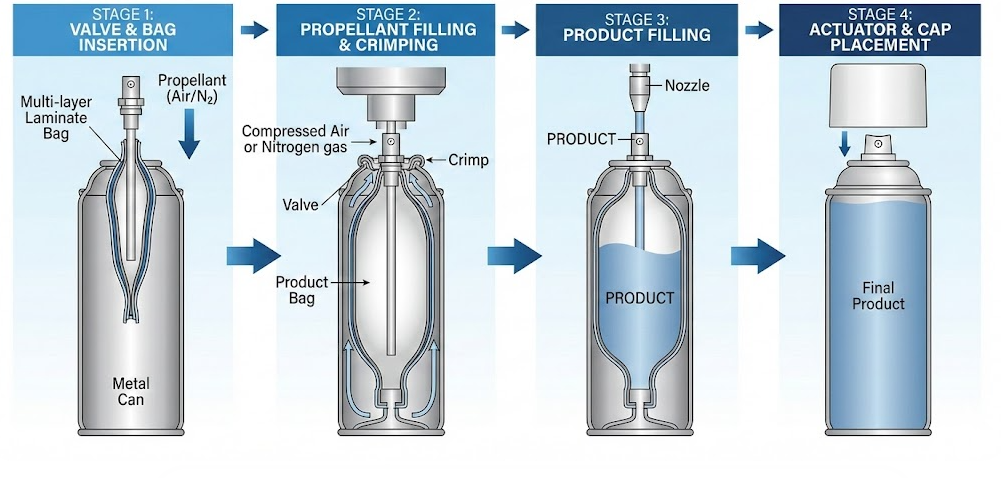
Bag-on-valve filling takes a different approach. A multi-layer laminated bag, sealed directly to the aerosol valve, is filled with product through the valve stem before crimping. The bag, now containing the product, is sealed inside the outer aluminum can. After crimping, compressed air or nitrogen is charged into the space between the bag and the can wall — the annular space that in a conventional aerosol would contain the product-propellant mixture.
When the actuator is pressed, the external propellant pressure squeezes the bag from the outside, forcing product out through the valve and actuator. The product itself never contacts the propellant at any point, from filling through the last dispensing event.
The result is a fundamentally different dispensing dynamic: product is expelled by external compression of the bag rather than internal vapor pressure pushing product up a dip tube. This single structural difference is what produces all of BOV’s distinctive performance advantages.
For a detailed look at how BOV technology works and what it’s used for across industries, see our complete bag-on-valve overview.
BOV Aerosol vs. Conventional Aerosol: Head-to-Head Comparison
Propellant Type and Flammability
This is one of the most practically significant differences between the two filling methods, and one that affects costs well beyond the production line.
Conventional aerosol uses liquefied hydrocarbon propellants (butane, isobutane, propane). These are flammable, which triggers a chain of requirements: flammability warnings on the label, DOT classification as a flammable aerosol for shipping, OSHA-compliant flammable propellant storage at the filling facility, and restricted shelf placement in some retail environments.
BOV uses compressed air or nitrogen — both inert, non-flammable, and non-reactive. A BOV can carrying compressed air is not classified as a flammable aerosol under DOT regulations. This simplifies shipping classification, eliminates flammability label requirements, and removes the retail shelf placement restrictions that apply to flammable aerosols. For brands selling through channels with strict flammability policies, or shipping via air freight where flammable aerosols face additional restrictions, BOV’s non-flammable propellant is a meaningful operational and cost advantage.
Product-Propellant Contact
In conventional aerosol, product and propellant are in direct, continuous contact. For many products (standard household sprays, many personal care applications, cooking oils stable under hydrocarbon exposure) this isn’t a problem. But for products that are oxygen-sensitive, contain natural or botanical actives that degrade under hydrocarbon exposure, or require sterile or pharmaceutical-grade production, direct propellant contact is a disqualifying constraint.
In BOV, product and propellant never meet. The laminated bag creates a complete physical barrier between them throughout the product’s life. This opens BOV to a wide range of applications that conventional aerosol simply cannot serve: sterile wound care sprays, premium natural personal care products, food-grade cooking sprays where propellant-free is a clean-label requirement, and any formulation where oxidation or hydrocarbon interaction would compromise efficacy or safety.
Spray Orientation
Conventional aerosol relies on a dip tube to draw product from the bottom of the can up to the valve when the can is held upright. Tip the can sideways or upside down and the dip tube loses contact with the product, dispensing becomes unreliable or stops entirely.
BOV eliminates the dip tube entirely. Because product is forced out by external compression of the bag — which works regardless of can orientation — BOV sprays reliably at any angle: upright, sideways, fully inverted. This 360-degree spray capability is a genuine functional advantage for products applied to hard-to-reach areas — the back, behind the knees, the scalp — and is often featured as a consumer-facing selling point on BOV-filled products.
Product Evacuation
With a conventional aerosol, product evacuation is limited by the dip tube’s ability to draw remaining product — typically leaving 5 to 15 percent of the fill weight in the can at the point where dispensing becomes unreliable. Consumers experience this as a product that ‘runs out’ before the can feels empty.
BOV’s bag collapses progressively as product is dispensed, allowing evacuation rates of up to 99 percent of the fill weight. Nearly every drop of product the consumer paid for reaches them — a meaningful value proposition for premium products and a strong retail story for brands competing on value and efficacy.
Shelf Life and Product Stability
In a conventional aerosol, the product is continuously exposed to the propellant and to whatever oxygen managed to enter the can before crimping. For products with active ingredients, natural components, or oxygen-sensitive chemistry, this exposure drives degradation over time — limiting shelf life and potentially affecting efficacy late in the product’s life.
The BOV bag creates a hermetically sealed environment that protects product from both propellant contact and oxidation throughout shelf life. Products that would degrade quickly in a conventional aerosol — natural oils, botanical extracts, active personal care ingredients, sterile medical preparations — maintain stability and efficacy significantly longer in BOV packaging. For brands making shelf life or efficacy claims, this is a production decision with direct marketing implications.
Environmental Profile
Conventional aerosol propellants are volatile organic compounds (VOCs) — they evaporate into the atmosphere when the can is used and contribute to ground-level ozone formation. California’s Air Resources Board (CARB) and other regulatory bodies place VOC content limits on specific aerosol product categories, and brands selling into regulated markets must ensure their propellant systems comply.
BOV’s compressed air and nitrogen propellants contain zero VOCs. For brands pursuing green, clean-label, or sustainability positioning, or selling into markets with strict VOC regulations, BOV’s environmental profile is a significant advantage — both for regulatory compliance and for consumer-facing sustainability claims.
Per-Unit Cost
This is where conventional aerosol holds a clear advantage. The laminated bag, bag-valve assembly, and specialized BOV filling equipment add cost to every unit relative to conventional aerosol production. At comparable volumes, BOV filling typically carries a modest per-unit premium over conventional aerosol filling.
For many brands, the BOV premium is offset — or more than offset — by the advantages it delivers: a higher retail price point supported by premium positioning, reduced regulatory and shipping compliance costs from the non-flammable propellant classification, and lower product waste from higher evacuation rates. Whether the premium makes sense depends on your product category, target retail price, and channel requirements. It’s a conversation worth having explicitly with your contract filling partner during the quoting process.
Filling Equipment and Partner Availability
Conventional aerosol filling is the established standard across the contract filling industry. Equipment is widely available, the process is well-understood, and nearly every aerosol contract filler offers it.
BOV filling requires dedicated, specialized equipment that not all contract fillers maintain. When BOV is the right format for your product, confirming that your prospective filling partner has active, operational BOV filling lines — not just stated intentions — is a critical step in partner selection. Signature Filling Company operates two dedicated BOV filling lines alongside conventional aerosol capability, making it one of the few full-service contract fillers equipped to run both formats for the same brand.
When to Choose Conventional Aerosol Filling
Conventional aerosol is the right choice when:
- Your product is chemically stable under hydrocarbon propellant exposure and does not require an oxygen-free environment
- Cost-per-unit is a primary driver and the product’s positioning does not support a premium price point
- The product is always dispensed upright and 360-degree spray capability is not a functional requirement
- Your distribution channel does not restrict flammable aerosols and you’re not shipping via air freight
- VOC content is within the applicable regulatory limits for your product category and target markets
- The product category has established consumer expectations for conventional aerosol format — many household cleaners, for example, where the format is standard and undifferentiated
When to Choose BOV Aerosol Filling
BOV is the right choice when:
- Your product is oxygen-sensitive, contains natural or botanical actives, or requires a sterile or pharmaceutical-grade production environment
- 360-degree spray at any orientation is a functional requirement or a meaningful consumer benefit
- Maximum product evacuation — up to 99 percent — is important for consumer value or for products where leaving residue in the can is unacceptable
- A non-flammable propellant classification is important for shipping, retail placement, or regulatory compliance in your target markets
- VOC-free positioning supports your brand’s sustainability, clean-label, or green product story
- Your product is food-grade and propellant-free production is a clean-label requirement
- Extended shelf life is a commercial or regulatory priority
- Premium positioning supports a retail price point that offsets the BOV per-unit cost premium
BOV and Conventional Aerosol Filling: Product Category Fit at a Glance
Personal Care
Both formats are used across personal care. Conventional aerosol dominates in standard deodorant, dry shampoo, and hair spray. BOV is increasingly preferred for premium sunscreen, natural deodorant, facial mist, self-tanner, and wound care — any product where oxygen sensitivity, propellant-free positioning, or 360-degree spray is a meaningful advantage.
Food
BOV is the clear choice for food-grade aerosol applications. Cooking spray, butter spray, and food-service oils all benefit from propellant-free product contact, clean-label compliance, and the full product evacuation that BOV delivers. Conventional aerosol’s hydrocarbon propellants are generally incompatible with food-grade clean-label requirements.
Household Products
Conventional aerosol is the established format for most household cleaners, air fresheners, and general-purpose sprays where cost efficiency, established consumer format expectations, and chemical compatibility are the primary drivers. BOV sees adoption in premium household products, natural cleaning lines, and applications where non-flammable classification is important for retail placement or shipping.
Medical and Wound Care
BOV is the dominant choice for medical-grade aerosol applications — topical wound care, saline sprays, antiseptics, and dermatological preparations — where sterile product-propellant separation, 360-degree spray, and pharmaceutical-grade shelf life stability are baseline requirements.
Insect Repellent
Both formats are used, but BOV is gaining ground in premium and family-focused repellent positioning. The non-flammable propellant classification simplifies retail shelf placement, and 360-degree spray allows application to feet, ankles, and the back without assistance. For natural and DEET-free repellent lines, BOV’s propellant-free product environment also better preserves sensitive plant-derived active ingredients.
The Bottom Line: BOV Aerosol vs. Conventional Aerosol
Neither filling method is universally superior — the right choice depends on your product, your target channel, your brand positioning, and your cost structure. What matters is making the decision deliberately, with a clear understanding of what each method delivers and constrains, rather than defaulting to convention or assuming one format fits every aerosol application.
The most useful thing you can do before making this decision is talk through your specific product with an experienced aerosol contract filling partner who operates both formats. A filler who only runs conventional aerosol will tell you conventional is fine. A filler who only runs BOV will tell you BOV is essential. A partner who runs both — and has placed products across both methods in multiple categories — can give you an honest, product-specific recommendation.
That’s the conversation Signature Filling Company is built to have. With dedicated BOV and conventional aerosol filling lines, certifications across food, personal care, household, and EPA-registered product categories, and experience across both filling methods, we can help you make the right call for your product — not just the easiest one.
Contact Signature Filling Company today to discuss which filling method is right for your project.

Frequently Asked Questions: BOV Aerosol vs. Conventional Aerosol
Is BOV aerosol filling always better than conventional aerosol?
No. BOV is superior for specific applications — oxygen-sensitive products, food-grade aerosols, medical-grade preparations, premium personal care with natural actives, products requiring 360-degree spray, and brands pursuing non-flammable or VOC-free positioning. For products without those requirements, conventional aerosol is a proven, cost-effective format. The right choice depends on your specific product and brand strategy.
Can the same aerosol can be used for both BOV and conventional filling?
Standard aluminum aerosol cans are compatible with both filling methods. The difference is in what’s inside the can: a BOV system adds the laminated bag and bag-valve assembly, which a conventional aerosol system does not use. The outer can and valve crimp are similar; the internal configuration and propellant charging method differ significantly between the two systems.
Why does BOV cost more per unit than conventional aerosol?
The per-unit cost premium for BOV filling comes primarily from two sources: the laminated bag and bag-valve assembly, which add component cost per unit, and the specialized BOV filling equipment, which represents a higher capital investment than conventional aerosol filling lines. For many brands, this premium is offset by higher retail price points, reduced flammability compliance costs, and better product evacuation rates.
Do BOV aerosol cans spray upside down?
Yes — reliably and by design. Because BOV product is expelled by external compression of the bag rather than by propellant vapor pressure pushing product up a dip tube, the can dispenses correctly at any orientation including fully inverted. Conventional aerosol cans with dip tubes cannot spray reliably upside down, as the dip tube loses contact with the product when the can is inverted.
Is BOV aerosol better for the environment than conventional aerosol?
BOV uses compressed air or nitrogen as propellants — both VOC-free and non-ozone-depleting. Conventional aerosol uses hydrocarbon propellants that are classified as VOCs and contribute to ground-level ozone formation. For brands with sustainability commitments, VOC content requirements in regulated markets like California, or clean-label positioning, BOV’s propellant profile is a meaningful environmental advantage.
Which filling method has a longer shelf life?
BOV-filled products typically demonstrate longer shelf stability than conventionally filled aerosols, particularly for products containing active ingredients, natural components, or oxygen-sensitive chemistry. The laminated bag creates a hermetically sealed environment that protects product from oxidation and propellant interaction throughout shelf life. Conventional aerosol products are in continuous contact with the propellant, which can accelerate degradation in sensitive formulations.
— Signature Filling Company | St. Louis, MO | signaturefillingcompany.com
