Aerosol Can Filling: How the Process Works
Aerosol Can Filling: How the Process Works and What Brand Owners Need to Know
If you’re bringing a pressurized product to market — a cooking spray, a personal care mist, a household cleaner, an insect repellent — the aerosol can is the delivery system. But the can itself is only part of the equation. The aerosol can filling process is what turns that packaging into a functional, shelf-ready product: product loaded, valve crimped, propellant charged, actuator installed, and every unit pressure-tested before it leaves the line.
For brand owners sourcing a contract filling partner for the first time, understanding what actually happens during aerosol can filling — and how the two primary filling methods differ — is the foundation for making good decisions about production partners, packaging formats, lead times, and cost structures.
This guide walks through the complete aerosol can filling process from start to finish, explains the key differences between conventional aerosol filling and bag-on-valve (BOV) filling, and covers what to look for when evaluating a filling partner. To learn more about Signature Filling Company’s capabilities, visit our products and services page.
The Anatomy of an Aerosol Can: Components That Make Filling Possible
Before walking through the filling process, it helps to understand the components that make up a finished aerosol can — because each one plays a role in how filling is executed and what can go wrong when it isn’t done correctly.
The Can Body
Aerosol cans are manufactured from either aluminum or tinplate steel. Aluminum cans are lightweight, corrosion-resistant, and the preferred choice for personal care, food-grade, and BOV applications. Tinplate steel cans are heavier-duty and commonly used for household products, industrial applications, and products requiring higher internal pressure tolerances. Can diameter and height determine fill volume capacity — standard sizes range from small personal care cans (approx. 2 oz) to large household product cans (approx. 20 oz and above).
The Valve
The valve is the mechanical heart of the aerosol system. Seated at the top of the can and held in place by the crimp, it controls the flow of product from the can interior to the actuator. Valve selection — stem diameter, spring tension, gasket material, and flow rate — directly affects how product dispenses: spray pattern, particle size, flow rate, and whether the product delivers consistently at different fill levels and orientations. Valve compatibility with the product and propellant type must be confirmed before filling begins.
The Actuator
The actuator — the button the consumer presses — determines the final spray geometry. Different actuator designs produce different outputs: a fine mist, a continuous spray stream, a fan pattern, a foam, or a directional jet. Actuator selection is both a functional decision (matching the product’s intended use) and a brand decision (shaping the consumer experience). Actuators must be compatible with the valve stem diameter and the product’s viscosity and particle characteristics.
The Propellant
The propellant is the pressurizing agent that drives product out of the can when the actuator is pressed. In conventional aerosol systems, the propellant — typically a hydrocarbon blend of butane, isobutane, and propane — is miscible with the product, meaning both share the same space inside the can. In bag-on-valve systems, the propellant occupies the space outside the bag and never contacts the product directly. Propellant type, fill pressure, and charge weight are all specified parameters in the filling process.
The Dip Tube (Conventional Aerosol Only)
In conventional aerosol systems, a plastic dip tube extends from the valve stem down into the product, drawing liquid up to the valve when the can is held upright. In BOV systems, no dip tube is needed — product is expelled directly from the bag regardless of can orientation, which is why BOV cans spray reliably at any angle including upside down.
How Aerosol Can Filling Works: The Step-by-Step Process
Aerosol can filling follows a defined sequence of steps on a certified filling line. The specific equipment and sequence vary between conventional aerosol filling and BOV filling, but the core logic — get product in, seal it, charge propellant, verify integrity — is consistent across both methods.
Step 1: Can Feeding and Inspection
Empty cans are fed onto the filling line from a depalletizer or magazine feeder. Before filling begins, cans pass through an initial inspection checkpoint — checking for dents, deformation, or surface defects that would compromise seal integrity or finished product appearance. Rejected cans are removed before they reach the fill station.
Step 2: Product Filling
Product is metered into the can by weight or volume at the fill station. Filling equipment is calibrated to deliver a precise fill weight within a defined tolerance — typically plus or minus one to two percent of the target fill weight. Fill accuracy is checked at regular intervals throughout the production run and documented in the batch record. Overfill creates pressure risk; underfill creates a compliance issue and a consumer experience problem.
Step 3: Valve Placement and Crimping
The valve assembly — valve body, gasket, and spring — is placed onto the can opening and crimped into place using a rotary or roller crimping head. The crimp creates a hermetic seal between the valve cup and the can bead. Crimp integrity is one of the most critical quality checkpoints in aerosol can filling: an improper crimp is the most common source of leaks and pressure failures. Crimp dimensions — depth, width, and tightness — are measured and recorded against specification at the start of each run and at regular intervals throughout production.
Step 4: Propellant Charging
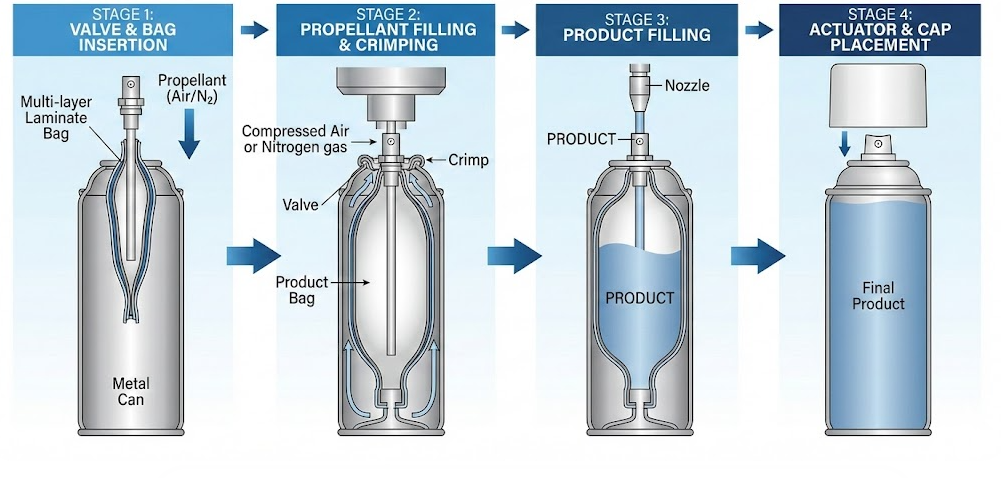
With the valve crimped, propellant is charged through the valve stem under pressure. In conventional aerosol filling, liquefied hydrocarbon propellant is injected into the headspace above the product and rapidly volatilizes to create the pressurized atmosphere inside the can. In BOV filling, compressed air or nitrogen is charged into the space between the outer can wall and the laminated bag — pressurizing the bag from the outside without any contact with the product inside.
Propellant charge weight and resulting internal pressure are both specified parameters. Pressure is verified after charging using a gauge check — cans outside the specified pressure range are rejected.
Step 5: Water Bath Testing
After propellant charging, filled cans pass through a water bath — a heated water tank, typically at 130 degrees Fahrenheit (54 degrees Celsius) — that serves two functions simultaneously. First, it checks for leaks: any can losing pressure will produce visible bubbling in the water, triggering automatic rejection. Second, the heat test simulates elevated temperature conditions aerosol cans may encounter in storage or transport, verifying that the can and valve can handle pressure at the upper end of the safe operating range. Water bath testing is a regulatory requirement under DOT standards for pressurized aerosol products and is performed on 100% of filled units.
Step 6: Actuator and Overcap Installation
Following the water bath, actuators are pressed onto the valve stems and overcaps are applied. Actuator seating is checked for proper engagement — a loose or misaligned actuator creates spray pattern inconsistency and a poor consumer experience. Overcap application may be manual or automated depending on the filling line configuration.
Step 7: Final Checkweigh and Visual Inspection
Finished cans pass through a final checkweigh station to verify that total filled weight — product plus propellant — falls within specification. Units outside the acceptable weight range are automatically diverted. Visual inspection catches actuator misalignment, overcap seating issues, and any surface defects that passed the initial can inspection.
Step 8: Labeling, Lot-Coding, and Finishing
Filled and inspected cans move through the labeling line for primary label application, followed by lot-code marking, tamper-evident seal application, and shrink sleeve application where specified. At a full-service aerosol filling and packaging facility like Signature Filling Company, all of these steps happen in-line — cans move from the fill line to finished, shelf-ready cases without leaving the facility.
Conventional Aerosol Filling vs. Bag-on-Valve Filling: Key Differences
The two primary aerosol can filling methods share the same general sequence but differ significantly in equipment, component complexity, propellant type, and what products they are best suited to handle.
Conventional Aerosol Filling
In conventional aerosol filling, product and propellant share the same space inside the can. Product is filled first through the open can top, the valve is crimped, and liquefied hydrocarbon propellant is pressure-injected through the valve stem. The propellant volatilizes and equilibrates with the product, creating the internal pressure that drives dispensing.
Conventional aerosol filling is well-established, broadly available, and cost-effective at scale. It works well for products that are chemically compatible with hydrocarbon propellants. Key constraints:
- Hydrocarbon propellants are flammable — requiring flammability labeling, DOT shipping classification as a flammable aerosol, and OSHA-compliant propellant storage
- Product contacts propellant — incompatible with oxygen-sensitive or sterile applications
- Dip tube dependency means the can must be held upright for reliable dispensing
- Hydrocarbon propellants emit VOCs — a consideration for green, clean-label, or California CARB-compliant positioning
Bag-on-Valve (BOV) Filling
BOV filling adds a multi-layer laminated bag — sealed to the valve — which contains the product. The bag is filled with product through the valve stem before crimping on specialized BOV filling equipment. After crimping, compressed air or nitrogen is charged into the space between the bag and the can wall. When the actuator is pressed, external propellant pressure collapses the bag from the outside, driving product out through the valve without any product-propellant contact.
The advantages BOV filling delivers:
- Compressed air or nitrogen propellant — non-flammable, eliminating flammability labeling and simplifying DOT shipping classification
- Zero product-propellant contact — protecting oxygen-sensitive, natural, or sterile products throughout shelf life
- 360-degree spray capability — dispensing reliably upside down, sideways, or at any angle
- Up to 99% product evacuation — nearly the full fill weight reaches the consumer
- Extended shelf life — the hermetically sealed bag protects contents from oxidation and microbial exposure
BOV filling requires specialized equipment not universally available across the contract filling industry. If BOV is part of your product strategy, confirm active BOV line capability with any prospective filler before advancing the conversation. Learn more about how the technology works on our bag-on-valve overview page.
Aerosol Can Sizes: Matching the Can to the Product and Channel
Can diameter, height, and volume capacity affect fill weight, shelf presence, consumer ergonomics, retailer compliance, and per-unit economics. Here’s how can sizing maps to common product categories:
Small Format (1-4 oz)
Used for travel-size personal care products, sample sizes, trial SKUs, and specialty applications where portability is the primary value. Common applications include travel deodorant, facial mist samples, travel sunscreen, and small personal care sprays.
Mid-Format (5-10 oz)
The most common range in personal care and household aerosol products — standard deodorant cans, cooking spray, insect repellent, air freshener, and most personal care aerosols sold at retail fall here. This size category carries the broadest actuator compatibility and the widest valve selection across the contract filling industry.
Large Format (11-20+ oz)
Serves household, industrial, and food-service applications — bulk cooking spray for commercial kitchens, large-format household cleaners, industrial lubricants, and professional-grade personal care products. Large-format cans require filling equipment capable of handling the higher fill weights and propellant charges these sizes require.
Can Diameter Standards
Aerosol can diameters follow industry standards — most commonly 45mm, 52mm, 57mm, 65mm, and 70mm. Diameter determines actuator and overcap compatibility. When evaluating contract filling partners, confirming that your target can diameter is supported by their equipment and component inventory avoids specification mismatches that delay production.
Quality Control in Aerosol Can Filling: What a Certified Filler Checks
Aerosol can filling is a regulated, safety-critical process. A certified aerosol contract filler maintains documented quality control checkpoints throughout the filling process — not just at the end of the line. Key checkpoints in a well-run operation include:
- Fill weight verification — at fill station startup, at regular intervals throughout the run, and via final checkweigh on every unit
- Crimp dimension measurement — crimp depth, width, and tightness checked against specification at startup and at defined intervals
- Propellant pressure verification — gauge check on sampled units after propellant charging
- Water bath leak testing — 100% of units pass through the water bath; any leaking unit is automatically rejected
- Spray pattern and actuator function check — sampled units tested for correct spray pattern, flow rate, and actuator engagement
- Label placement and print quality inspection — label registration, adhesion, and readability verified
- Lot code legibility — every unit’s lot code verified for completeness and readability
- Finished goods inspection — case configuration, count, and appearance verified before palletizing
According to the Consumer Specialty Products Association (CSPA), rigorous in-process quality control — documented, traceable, and auditable — is the baseline expectation for aerosol contract fillers supplying major retail and distribution channels.
What to Look for in an Aerosol Can Filling Partner
1. Filling Method Capability — Conventional, BOV, or Both
Confirm that the partner’s filling equipment matches your product’s format requirements. Not all aerosol contract fillers have BOV capability. If your product strategy includes BOV filling, verify active BOV line capability before advancing the conversation.
2. Certifications for Your Product Category
Food-grade aerosols require SQF certification. Personal care aerosols benefit from ISO 22716 GMP certification. OTC drug aerosols require FDA facility registration. EPA-registered pesticide aerosols require EPA establishment registration. A filling partner holding all relevant certifications eliminates the need to qualify separate vendors as your product line expands.
3. Can Size and Component Range
The partner’s equipment and component inventory determines what can sizes, diameters, valve types, and actuator styles are available to you. A filler with a narrow component range limits your packaging options and may not support future SKU extensions without significant lead time or tooling costs.
4. In-Line Finishing Capability
Labeling, lot-coding, tamper-evident sealing, and shrink sleeve application should happen at the same facility as filling. A filling partner that ships cans out for separate finishing introduces transit handling risk for pressurized product, additional lead time, and a second quality system to verify.
5. Documented In-Process Quality Control
Ask specifically about in-process quality control — not just end-of-line inspection. Request a sample batch record format to understand what documentation travels with your production run.
6. Flexible Run Sizes
Large commodity fillers often require minimums of 50,000 to 100,000+ units. A filling partner with genuinely flexible run sizes avoids forcing you into inventory positions your sales can’t yet support — important for launches, seasonal SKUs, and multi-variant testing.
7. Propellant Handling Compliance
Aerosol propellant handling requires OSHA-compliant storage, handling, and facility design. Confirm that your filling partner maintains current compliance with applicable fire codes, OSHA standards, and DOT regulations for pressurized product storage and shipping.
Aerosol Can Filling at Signature Filling Company
Signature Filling Company is a St. Louis-based aerosol contract filling and packaging company serving food, personal care, and household product brands. We operate both conventional aerosol and bag-on-valve filling lines, with full in-house finishing capability under one roof.
Our aerosol can filling capabilities include:
- Conventional aerosol and BOV filling on dedicated, certified equipment
- Wide range of can sizes, diameters, valve types, and actuator configurations
- Compressed air and nitrogen propellant capability for BOV applications
- 100% water bath leak testing on every unit
- In-process quality control with documented batch records
- In-line labeling, lot-coding, tamper-evident sealing, and shrink sleeve application
- Flexible run sizes for launches, seasonal SKUs, and scale production
- SQF, ISO 22716 GMP, FDA, and EPA certifications across product categories
Contact Signature Filling Company today to discuss your aerosol can filling project.
Frequently Asked Questions: Aerosol Can Filling
What is the difference between conventional aerosol filling and BOV filling?
In conventional aerosol filling, product and hydrocarbon propellant share the same space inside the can. In BOV filling, product is sealed inside a laminated bag attached to the valve, and compressed air or nitrogen pressurizes the space outside the bag. BOV cans spray at any angle and use non-flammable propellants; conventional aerosols require an upright orientation and use flammable hydrocarbon propellants.
What is a water bath test in aerosol can filling?
A water bath test passes filled aerosol cans through a heated water tank — typically 130 degrees Fahrenheit — to check for leaks and verify the can can safely withstand elevated temperature conditions. Any can leaking pressure produces visible bubbling and is automatically rejected. Water bath testing is a DOT regulatory requirement and is performed on 100% of filled units in a compliant operation.
How is fill weight controlled during aerosol can filling?
Fill weight is controlled by calibrated filling equipment metering product at the fill station within a defined tolerance. Weight is verified at startup, at regular in-process intervals, and via automatic checkweigh on every finished unit. Fill weight documentation is part of the batch record for every production run.
What propellants are used in aerosol can filling?
Conventional aerosol filling uses liquefied hydrocarbon propellants — typically blends of butane, isobutane, and propane. BOV filling uses compressed air or nitrogen, which are inert, non-flammable, and non-reactive. Propellant type affects flammability classification, shipping and storage requirements, and compatibility with the product.
What can sizes are available for aerosol can filling?
Standard aerosol can sizes range from approximately 2 oz up to 20+ oz. Common diameters include 45mm, 52mm, 57mm, 65mm, and 70mm. The specific sizes available depend on the contract filler’s equipment and component inventory — confirm your target size and diameter are supported before finalizing your packaging specification.
How long does an aerosol can filling production run take?
For runs using standard components and previously approved packaging, lead time from order confirmation to finished goods is typically four to eight weeks. First-time production runs requiring component sourcing, label production, and pre-production approval generally require ten to fourteen weeks or more from initial engagement to shipment.
